Categories
All Etiquette Articles

What to say to someone who has lost a loved one

Lost loved one
Photo credit: Adobe Stock Photo

What to say to someone who has lost a loved one

At one time or another, we all lose a loved one or dear acquaintance. It is a sad fact of life that some of us deal with better than others — though pain can also be buried or reveal itself in a variety of ways.


At such devastating times, we need the comfort and support of our friends and family. But death is a painful topic of conversation for many people.


So what do you say to someone who is grieving?


And more importantly, what don’t you say?


1) Share a fond memory.


A happy, heartfelt story about a loved one helps the bereaved person focus on the happy memories instead of the sorrowful times.


“Jim was the most generous guy I ever met, especially when he helped me install my new sprinkler system last summer,” you might say to a friend. “I will always remember his thoughtfulness.” Specifics like these work wonders.


2) Say something or write a letter.


If you are at a loss for words, simply be honest and acknowledge that: “There are no words,” or “I wish there was something I could say to help ease your pain.”


If you aren’t comfortable saying anything, a warm hug can do wonders.


If you still aren’t comfortable expressing your condolences in person, you should do so in writing. It’s always appropriate (and good etiquette) to send a sympathy card or a letter just letting someone know you care.


3) Neutralize your comments. 


When you comfort someone with different beliefs, refrain from saying things like, “It was God’s plan,” and “God gained another angel.” You can seem insensitive when what you intend is the very opposite of that.


“He’s in a better place,” or “It was for the best,” may also come across as insensitive — especially to parents who have lost a child. When told her son was in a “better place” after losing him at birth, a friend of mine was far more upset than comforted.


Instead, you might say, “Just remember, I’m here for you.” Or, “Please know I’m holding you (and your precious baby) in my heart.”


4) Focus on the grieving person.


When someone loses a loved one, he is more concerned about his own grief — not yours. “I know exactly how you feel. I lost my mother last year,” or “I know what you’re going through,” are insignificant comments to the bereaved person. You probably don’t know how that person feels at all — since everyone grieves differently.


6) Respect the person’s privacy.


Most people are curious to know how a person passes away. However, don’t get too personal or invasive by asking questions. The cause of death may be irrelevant to the one who is grieving. Allow that person time to share the details with you when appropriate.


Some people may take longer to share details and, in that case, the best gifts you can give are space and time.


7) Lend a helping hand.


Actions often speak louder than words. Instead of saying, “Call me if I can do something for you,” take the initiative and just do it. Those who are grieving don’t want to make any more decisions than absolutely necessary, so they most likely won’t call you.


Offer to take the person out to lunch or to a movie. Offer to make food, buy groceries, clean the house, or help make phone calls. If they have small children, offer to take care of them if you are able. Your constant friendship and small favors will be more meaningful and beneficial in the long run.


8) Concentrate on the present, not the future.


It’s never a good idea to ask a widow or widower if they think they will marry again. Furthermore, never say, “I guess you can now join us for singles night,” “I’ve already picked out your next husband (or wife),” or “If you plan on selling your spare car — please keep me in mind.”


The bereaved person can do without these types of comments.


Imagine yourself in their shoes — what would help you most to hear?

Ask the Etiquette Expert

Categories
All Etiquette Articles

8 Business Networking Tips for Introverts

Introverts
Credit: Adobe Photo

8 Business Networking Tips for Introverts

One thing most people don’t know about me is that I have to “work” at networking. It doesn’t come easy to me and it can sometimes be downright uncomfortable at times.


I teach networking skills to business men and women all over the world and many of them experience the same anxiety I feel when I walk into a room full of strangers. Although I wouldn’t consider myself an introvert, I do empathize with many friends who are shy or intimidated when they are in social settings.


Networking can be challenging for anyone, but especially for introverts. If you’re an introvert, you probably tend to do well in smaller, more intimate settings, where you know one or more people. To help you improve your networking skills, here are several tips:


  1. Temper expectations: Try not to set unrealistic expectations for how many connections you need to make. Networking isn’t a numbers game. It’s more about quality than quantity.

  2. Plan ahead: Think of some good icebreakers, such as open-ended questions that can spur conversation. For instance, you could ask, “What’s your favorite part of your job?” or “How do you know the hosts of this event?”

  3. Set a departure time: Decide when you’d like to leave a networking event ahead of time. This often makes the situation far less intimidating. You may get comfortable in the environment quickly and stay longer than you anticipated.

  4. Use mutual contacts: If there is a specific person you want to meet, find a common connection, to see if he or she can introduce you. Rather than just approaching someone out of the blue, it helps to find a mutual acquaintance to foster a stronger relationship.

  5. Use your listening skills: Introverts are known to be great listeners so you probably have a leg up on others who talk too much at networking events. Your listening skills will help you stand out as someone who values others’ comments and opinions, which can give people more of a reason to remember you.

  6. Get personal: Asking multiple questions without ever sharing any information about yourself can make people feel as if they’re being interrogated. A conversations is like a two-way street. Share personal information, like your hobbies and interests, as a way to help others remember you once the event is over.

  7. Practice: If you are nervous about networking, challenge yourself with no-risk or low-risk situations. Attend an out-of-town event where you don’t know anyone and then practice your networking skills. This will provide you with an opportunity to experiment with new conversations or stories.

  8. Take baby steps: Not all networking needs to take place at a specific “networking” event. Take advantage of everyday situations. Casually socialize with colleagues around the office or invite a different coworker to lunch each week.

My hope is that these tips and other tips I share on Entrepreneur.com will give you more confidence and help you make more connections in your business and social life.

Ask the Etiquette Expert

Categories
All Etiquette Articles

8 Tips to Pen a Perfect Thank-You Note

Thank you note
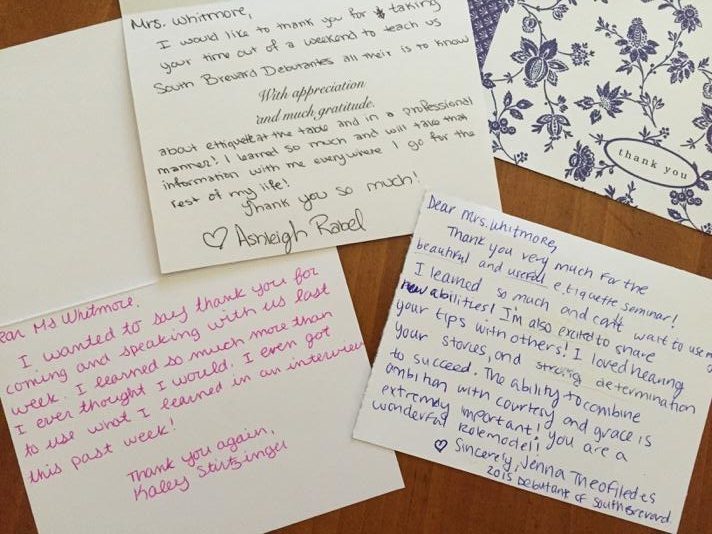
These thank-you notes were sent to me by some of my students. Priceless!

8 Tips to Pen a Perfect Thank-You Note

Whenever someone does something nice for you, it’s always a good idea to show your appreciation. However, if you want to stand out from the crowd, don’t send a text or email. Send a handwritten note instead.

With the proliferation of social media, it seems that handwritten correspondences have gone the way of the dinosaurs. Yet don’t you remember the excitement of receiving a card or letter through the mail when you were young? It was tangible, handwritten in the script of the sender. You enjoyed holding it and how it felt.


A handwritten note can be picked up time and again to be reread for new understanding and connection. Many people. including me, keep their most treasured thank-you notes in a safe place. They remind us that someone cared enough to take the time to think of us.

Handwritten notes are just as relevant today, or even more so, as they were a hundred years ago. Here are some tips to crafting the perfect thank-you note.


1. Purchase quality stationery.


You’ll be more apt to write a quick thank-you note if you have nice note cards on hand. Purchase foldover or correspondence cards embossed with your own name. Customized note cards can be obtained through retail office supply stores or online specialty stationery stores. If you want to showcase your uniqueness and do something special for yourself, hire a calligrapher to design your stationery and capture your personal brand.


Master calligrapher Bernard Maisner, who designed my personal stationery and whose work has been featured in window installations at Tiffany’s and Bergdorf Goodman in New York, believes that calligraphy answers a demand for beauty and vitality that technology, however advanced, cannot. Calligraphy,” he says, “is not meant to reproduce something over and over. It’s meant to show the humanity, the responsiveness and variation within.”


2. Craft a relevant message.


In addition to writing “thank you,” acknowledge the recipient’s generosity and say a few words about how their action made you feel, or how you used or will use what you received. Reference a single moment that made an impact on you to make your message personal and heartfelt.


3. Don’t worry about being elegant.


A simply-written note makes more connection than awkward formality. Write from the heart as if you were speaking to the recipient in person. Keep it short and sweet.


4. Do it yourself.


A sincere nthank-you note cannot be outsourced to an assistant or online service. Don’t blow your opportunity to make a good impression with a canned presentation.


5. Always write by hand.


Even if you don’t have steller penmanship, do your best. The message will be felt through your words, regardless of how your handwriting looks. It helps to practice what you want to say by writing out your message on a plain piece of paper before putting it on your note.


6. Consider your sign-off.


In business letters, you generally sign “Sincerely” or “Best regards.” However, a more personal note deserves a more intimate send-off. Instead of using a redundant “thank you again,” consider a warmer closing such as “With sincere appreciation” or “Yours truly,” then sign your name.


7. Choose a decorative postage stamp.


Take the extra step of purchasing stamps from the post office. There are many designs available, from patriotic to commemorative to scenic. Select a few sets that expresses your personality. Just don’t run your thank you note through the postage machine.


8. Send it immediately.


The sooner you send the thank-you note, the better. Your promptness will be appreciated. It also demonstrates that even though you are a busy person, you still have time for the personal touch. If you forget to send your thank-you note, don’t be embarrassed about it. Instead, take action. It’s better received late than never.


The gifts we receive aren’t all tangible, but they can cost us a heavy price if we fail to say thanks. Whenever someone gives you their time, advice or helping hand, that’s reason enough to express your gratitude in a handwritten thank-you note. It’s one of the surest ways to make connections, strengthen emotional ties and forge friendships and business relationships.

Ask the Etiquette Expert

Categories
All Etiquette Articles

6 Actions You Can Take Every Day to Build Your Self-Confidence

Self confidence
Credit: Adobe Photo

6 Actions You Can Take Every Day to Build Your Self-Confidence

Even the greatest leaders lack self-confidence at certain times. Self-confidence is not a static quality; rather, it’s a mindset that takes effort to maintain when the going gets rough. It must be learned, practiced and mastered just like any other skill. But once you master it, you will be changed for the better.


Here are six effective ways to promote your own self-confidence.


1. Act the part.


Your body language can instantly demonstrate self-assuredness, or it can scream insecurity. Present yourself in a way that says you are ready to master or take command of any situation. If you look confident and act the part you aspire to reach, you’ll not only feel in control, people will have much more confidence in you as well.


Hold your head high, sit up straight, gently bring your shoulders back to align your spine and look directly at the other person when interacting. Avoid a limp handshake and maintain good eye contact while someone is speaking to you.


2. Dress the part.


When you look better, you feel better. If you choose clothing and accessories that fit you well, suit your industry and lifestyle, and make you feel good, this will automatically increase your self-esteem. Look like the part you want to play, or in other words, suit up for success. Don’t be afraid to let your personality shine in your accessories. Bold jewelry or a colorful tie can be a focal point and a good conversation starter.


3. Speak assertively.


The next time you listen to your favorite speaker, be mindful of the way he or she delivers a speech. A great speaker speaks confidently, in a steady, rhythmic tone. Instead of the “ums” and “ahs” that interrupt flow, they use pauses to emphasize ideas.


Adopt an assertive, but not aggressive, way of speaking that indicates your self-confidence. You will feel your self-esteem begin to rise. To be taken seriously, avoid high-pitched, nervous chatter or twittering giggles in your speech. People will listen to you more attentively when they see the leader radiate from within you.


4. Think and act positively.


Positive energy leads to positive outcomes, so set your mind to the can-do side of any situation, avoiding the negative self-talk that can make you feel less confident. Smile, laugh and surround yourself with happy, positive people. You’ll feel better and the people with whom you work will enjoy your company.


Keep a gratitude journal to remind yourself of the high points of your day and your accomplishments. You will develop more peace and confidence when you are in a grateful state of mind.


5. Take action.


There’s more to being confident than just how you look. You must act the part. Walk up to a stranger at a networking event, or accept a project you’d normally reject. Practice being self-confident and soon it will become second nature.


Inaction breeds doubt and fear, while action breeds confidence and courage. As an exercise, jot down your strengths and weaknesses. Most people will tell you to work on your weaknesses, but use what you’ve got and capitalize on your strengths instead. Once you put more energy into your positive traits, your confidence will start to shine through.


6. Be prepared.


Remember the five P’s: Prior planning prevents poor performance. The more prepared you are, the more confident you’ll feel about your expertise and competency. Preparation will help you avoid getting tripped up by life’s unexpected glitches.


Learn everything you can about your industry, your subject matter, your goals and what drives you towards success. Before you start a task, first imagine how you want to feel once you’ve completed it. Don’t try to accomplish too much at once. Break complex tasks up into small, bite-size, manageable pieces.


As U.S. Army General Creighton Williams Abrams Jr. once said, “When eating an elephant take one bite at a time.” If you have patience and perseverance, you are only steps away from a more confident you.

Ask the Etiquette Expert